Forex, A Complete Beginner's Guide to Currency Trading
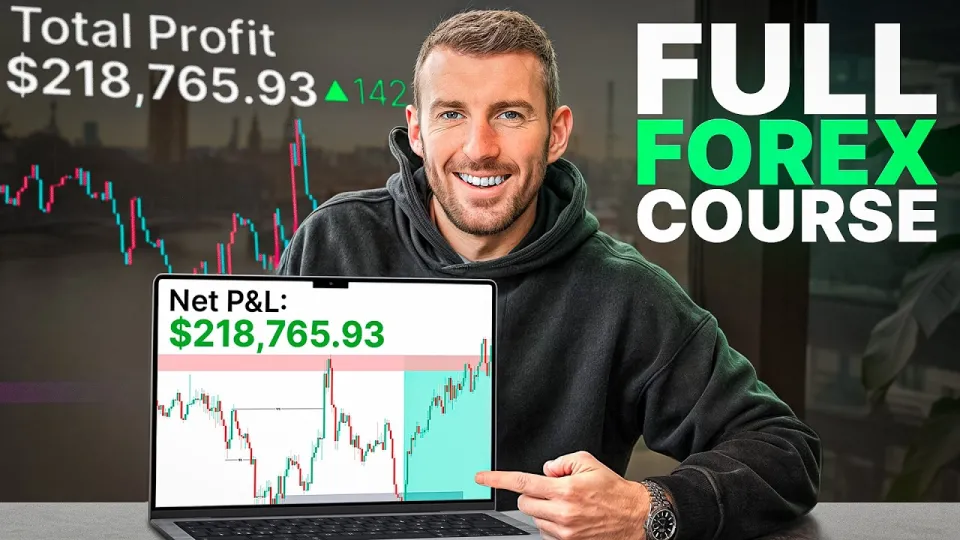
Video: Beginners Guide To Forex Trading In 2026 (+3 hours)
Want articles like this for your own video to promote it on YouTube and Google? Order them through the Telegram bot @sat_sit_bot. The bot writes and publishes the articles itself (with your YouTube video embedded) on popular topical websites (no ads). Free trial — 50 articles.
· based on the channel Matt Donlevey - Photon Trading
Forex trading is the act of buying and selling currency pairs on the foreign exchange market, the largest and most liquid financial market in the world. For beginners, it offers both opportunity and risk, and the key to success lies in understanding market mechanics, developing a repeatable strategy, and managing risk. A solid starting point is the free Photon Trading course, which provides a comprehensive foundation: Get the free Photon Trading course and cheatsheets.
What Is Forex Trading and How Does It Work?
Forex trading involves speculating on the price movements of currency pairs such as EUR/USD or GBP/JPY. Unlike stock exchanges, forex is decentralized and operates over-the-counter (OTC) through a network of banks, brokers, and liquidity providers. The market runs 24 hours a day, five days a week, across major financial centers like London, New York, Tokyo, and Sydney.
Currencies are quoted in pairs, with the first currency being the base and the second the quote. For example, if EUR/USD is trading at 1.1000, it means one euro buys 1.10 US dollars. Traders profit by correctly predicting whether the base currency will strengthen or weaken against the quote currency.
Leverage is a defining feature of forex, allowing traders to control large positions with relatively small capital. While leverage can amplify profits, it also magnifies losses, so understanding margin requirements and risk management is critical.
How Much Money Can You Make Trading Forex?
There is no fixed income in forex; returns depend on strategy, risk tolerance, and market conditions. Some traders aim for consistent monthly gains of 2–5% on their account, while others pursue more aggressive targets. However, it's important to approach forex with realistic expectations: many beginners lose money initially due to lack of discipline and proper risk control.
Professional traders often focus on risk-reward ratios and win rates. For instance, with a 1:2 risk-reward ratio and a 50% win rate, a trader can be profitable over time. The video emphasizes that making money in forex is not about predicting the future but about executing a well-defined edge consistently.
How to Trade Other People's Money
Trading other people's money (OPM) is a way to scale earnings without risking personal capital. This can be done through proprietary trading firms, where traders are given access to funded accounts in exchange for a share of profits. The Photon Trading mentorship program, for example, offers a path to become a funded trader with up to $400k in capital within 12 months.
To succeed in OPM, traders need a proven track record, often demonstrated through backtesting and live trading results. Prop firms typically require traders to pass an evaluation phase with specific profit targets and risk limits. Once funded, traders keep a significant portion of profits, often 70–90%.
Core Concepts: Market Dynamics and Order Flow
Understanding market dynamics is essential for building a strategy based on real market logic. The video stresses that technical analysis alone—relying solely on geometric patterns—is insufficient because it doesn't explain why price moves. Instead, traders should study market microstructure, order flow, and auction market theory.
Market microstructure deals with the mechanics of trading: bid, ask, spread, and order book. The bid is the price buyers are willing to pay, the ask is the price sellers are asking, and the spread is the difference between them. The order book shows pending orders at various price levels, providing insight into supply and demand.
Auction market theory suggests that markets are constantly seeking fair value through the interaction of buyers and sellers. Order flow—the actual volume of buy and sell orders—reveals the balance of power between bulls and bears. By analyzing order flow, traders can identify imbalances and potential turning points.
Building a Trading Strategy: The Photon Approach
The Photon strategy is a systematic framework built on market structure, supply and demand, and liquidity concepts. It begins with understanding market structure—the sequence of higher highs and higher lows (uptrend) or lower highs and lower lows (downtrend). There are three types of structure: trending, ranging, and transitioning.
Premium and discount pricing helps identify whether an asset is relatively expensive or cheap within a range. Multi-timeframe analysis ensures that trades align with the broader trend. Supply and demand zones pinpoint areas where institutional orders are likely to be placed, while liquidity concepts explain how price moves to areas of high liquidity to fill large orders.
The strategy also covers trade entries, management, and money management. Entries are typically taken at key levels with confirmation from order flow. Trade management involves setting stop-loss and take-profit levels, and adjusting positions as the market evolves. Money management rules, such as risking no more than 1–2% per trade, protect the account from significant drawdowns.
Common Mistakes and How to Avoid Them
Many beginners fall into traps that hinder their progress. Three common mistakes highlighted in the video are: overleveraging, lack of a trading plan, and poor psychology. Overleveraging occurs when traders take positions too large for their account size, leading to rapid losses. A trading plan defines entry and exit criteria, risk parameters, and position sizing. Without it, traders make impulsive decisions.
Psychology is another critical factor. Fear and greed can lead to deviating from the plan. The video suggests mastering the strategy first and then focusing on psychological aspects, as confidence in a proven edge reduces emotional interference.
Step-by-Step: Creating Your Trade Plan and Backtesting
A trade plan is a written document that outlines your strategy, risk management rules, and daily routine. It should include:
- Market analysis: which pairs to trade and during which sessions.
- Entry and exit criteria: specific conditions for entering and exiting trades.
- Risk management: maximum risk per trade, daily loss limit, and position sizing.
- Trade journaling: recording trades to review performance.
Backtesting involves testing your strategy on historical data to assess its viability. This can be done manually or with specialized software. The goal is to ensure the strategy has a positive expectancy before risking real money.
Choosing a Broker and Understanding Trading Costs
Selecting a reliable broker is crucial. Consider regulation, execution speed, spreads, commissions, and customer support. Trading costs include spreads, commissions, and swap rates (overnight financing). These costs can significantly impact profitability, especially for high-frequency strategies.
Execution involves placing orders through the broker's platform. Understanding order types—market, limit, stop—is essential. Trade journaling helps track performance and identify areas for improvement.
Useful Links
- Free Photon Trading Course + Cheatsheets
- Photon Mentorship Program
- Free Telegram Channel
- Instagram: @photontrading
Final Thoughts
Forex trading is a skill that requires education, discipline, and practice. The free course by Matt Donlevey - Photon Trading offers a comprehensive curriculum that covers everything from market basics to advanced concepts like order flow and liquidity. By following a structured approach, creating a trading plan, and managing risk, beginners can build a solid foundation for long-term success. Remember, trading is not a get-rich-quick scheme; it's a profession that demands continuous learning and adaptation. For those ready to take the next step, the free Photon Trading course is an excellent starting point.
Key takeaways
- Forex is the world's largest financial market with daily volume exceeding $7 trillion.
- Retail traders can start with as little as $100, but proper risk management is crucial.
- The Photon Trading free course offers over 3 hours of structured forex education.
- Key concepts include market microstructure, order flow, supply and demand, and liquidity.
- A trading plan and journaling are essential for long-term success.
Source: Beginners Guide To Forex Trading In 2026 (+3 hours) · Markdown version
Questions & answers
How long does it take to learn forex trading?
Learning forex basics can take a few weeks, but becoming consistently profitable often takes months or years of practice. The 3-hour video provides a solid foundation, but hands-on experience with a demo account and backtesting is essential to develop skill.
Can I trade forex with a small account?
Yes, many brokers allow accounts with as little as $100, but leverage and risk management are critical. With a small account, focus on preserving capital and learning rather than chasing large profits. Micro lots can help control risk.
Is forex trading risky?
Forex trading carries significant risk due to leverage and market volatility. Most retail traders lose money, so it's vital to use stop-loss orders, risk only a small percentage per trade, and never invest money you can't afford to lose.
What is the best strategy for beginners?
Beginners should start with a simple, rule-based strategy that focuses on market structure and supply/demand zones. The Photon strategy taught in the video emphasizes understanding order flow and liquidity, which provides a logical framework for entries and exits.